
Introduction
When a patient is admitted with a serious gastrointestinal or liver-related condition, the immediate focus is naturally on stabilizing the patient, controlling the underlying disease and preventing complications. But there is another aspect of critical care that can sometimes receive less attention: nutritional and micronutrient status.
Patients with prolonged illness, poor oral intake, vomiting, malabsorption, alcohol-related disease, liver dysfunction or prolonged hospitalization may be particularly vulnerable to nutritional deficiencies. In critically ill patients, metabolic requirements can also change considerably, making nutritional assessment an important part of supportive care.
Among these micronutrients, B-complex vitamins and vitamin C have important physiological roles in energy metabolism, cellular function and antioxidant defense.
This is where a clinically considered injectable vitamin combination can become relevant as part of an overall nutritional and supportive-care strategy.
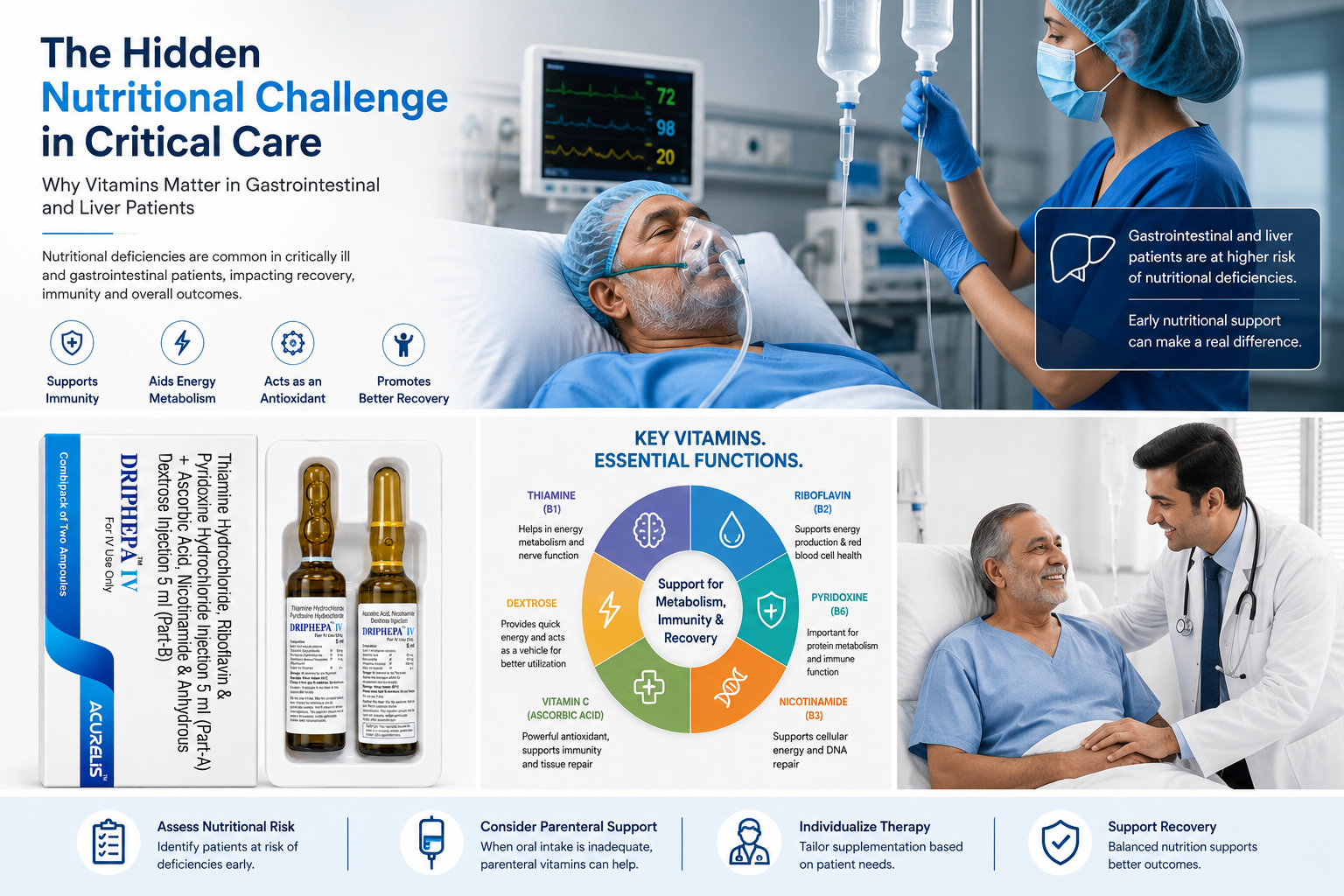
One such formulation is DRIPHEPA, an injection kit containing:
- Ampoule A: Thiamine, Riboflavin & Pyridoxine
- Ampoule B: Ascorbic Acid, Nicotinamide & Dextrose
The following article looks at why vitamin support deserves attention in gastrointestinal and critical-care settings and where such formulations may fit into clinical practice.
Why Are Gastrointestinal Patients at Risk of Nutritional Deficiencies?
The gastrointestinal tract plays a central role in digestion and nutrient absorption. Therefore, conditions that affect the gastrointestinal system can also affect nutritional status.
Patients experiencing persistent vomiting, poor appetite, diarrhea, malabsorption or prolonged inability to take food orally may have inadequate intake of essential vitamins and nutrients.
The situation can become more complicated in critically ill patients. Increased metabolic stress, inflammation, reduced nutritional intake and certain medical interventions can contribute to altered micronutrient requirements. Critically ill patients may therefore require careful assessment of their nutritional status rather than relying solely on routine dietary intake.
This becomes particularly relevant in patients with severe gastrointestinal illness, liver disease, prolonged hospitalization and those requiring intensive care.
Thiamine: A Vitamin with Particular Importance in Critical Care
Thiamine (Vitamin B1) plays a fundamental role in carbohydrate metabolism and cellular energy production.
The importance of thiamine becomes especially apparent in patients who are nutritionally depleted. Severe thiamine deficiency can result in neurological and cardiovascular manifestations, while Wernicke encephalopathy is a recognized clinical consequence of significant deficiency.
Importantly, thiamine deficiency is not limited to patients with alcohol dependence. It can also occur with severe malnutrition, prolonged vomiting, certain gastrointestinal conditions, prolonged parenteral nutrition and other situations associated with inadequate intake or absorption.
This is why clinicians should remain alert to the possibility of thiamine deficiency when assessing vulnerable hospitalized patients.
Clinical guidance has emphasized early parenteral thiamine administration in patients considered at risk of deficiency, particularly when oral administration or absorption may be unreliable.
The Role of Other B Vitamins
Riboflavin (Vitamin B2) participates in the formation of flavin coenzymes involved in energy metabolism and electron transport.
Pyridoxine (Vitamin B6) is involved in numerous enzymatic reactions, including amino-acid metabolism and neurotransmitter synthesis.
Nicotinamide (Vitamin B3) contributes to the formation of NAD and NADP, molecules involved in energy production and cellular metabolic reactions.
In critically ill patients, these micronutrients can become particularly relevant because metabolic pathways are under considerable stress. Contemporary reviews of micronutrients in critical illness discuss the physiological importance of thiamine, riboflavin, vitamin B6 and niacin-related compounds, while also highlighting that evidence for high-dose supplementation should be interpreted carefully and within the clinical context.
The objective, therefore, is not simply to administer vitamins routinely to every patient. Instead, nutritional risk assessment and appropriate clinical judgment should guide supplementation.
What About Vitamin C in Critically Ill Patients?
Vitamin C, or ascorbic acid, is a water-soluble vitamin involved in several physiological processes and antioxidant mechanisms.
Critical illness is associated with significant metabolic and oxidative stress. Research into micronutrients in critical care has therefore examined vitamin C and other antioxidant nutrients in this setting. However, evidence surrounding pharmacological doses of vitamin C in critically ill patients remains an evolving area of research.
This distinction is important.
Vitamin supplementation should not be presented as a replacement for definitive treatment of sepsis, liver failure, gastrointestinal bleeding, infection or any other serious condition. Instead, appropriate vitamin supplementation can form one component of comprehensive supportive care when clinically indicated.
Why Injectable Vitamin Support Can Be Considered
In patients who are unable to consume adequate nutrition orally, the route of administration becomes an important consideration.
Severe gastrointestinal symptoms, altered consciousness, prolonged vomiting or other clinical circumstances may make oral supplementation difficult or unreliable. In such situations, healthcare professionals may consider parenteral administration when clinically appropriate.
Hospital nutrition guidelines recognize the role of parenteral micronutrient provision in selected patients, particularly when nutritional requirements cannot be adequately met through the gastrointestinal route.
This is one reason injectable vitamin formulations remain relevant in hospital and critical-care practice.
DRIPHEPA: A Dual-Ampoule Injectable Vitamin Combination
DRIPHEPA is an injectable vitamin combination designed around two complementary ampoules.
Ampoule A
Thiamine + Riboflavin + Pyridoxine
This combination brings together three B vitamins involved in energy metabolism and multiple enzymatic processes.
Ampoule B
Ascorbic Acid + Nicotinamide + Dextrose
The second ampoule combines vitamin C and nicotinamide with dextrose, providing a formulation designed for use as part of supportive nutritional management according to the treating physician’s judgment.
The two-ampoule presentation provides a practical combination of important water-soluble vitamins in an injectable format.
For clinicians managing patients with nutritional risk, gastrointestinal illness or critical-care requirements, formulations such as DRIPHEPA may be considered when vitamin supplementation through the parenteral route is clinically appropriate.
Gastrointestinal and Liver Patients: Think Beyond the Primary Diagnosis
A useful way to approach critically ill gastrointestinal patients is to look beyond the primary diagnosis.
A patient admitted with severe gastrointestinal disease may simultaneously have:
- Poor oral intake
- Prolonged vomiting
- Nutritional depletion
- Increased metabolic requirements
- Electrolyte abnormalities
- Vitamin deficiencies
- Altered mental status
- Liver dysfunction
- Increased risk of complications during nutritional rehabilitation
For example, patients with advanced liver disease can have significant nutritional challenges. Current guidance for hospitalized patients with acute-on-chronic liver failure emphasizes early nutritional support and monitoring for complications such as refeeding syndrome, particularly in malnourished patients.
Therefore, nutritional assessment should be considered alongside the management of the underlying gastrointestinal or hepatic condition.
The Importance of Individualized Clinical Assessment
It is important to remember that vitamin injections are not a substitute for diagnosis or definitive treatment.
A patient with gastrointestinal bleeding requires appropriate management of the bleeding. A patient with sepsis requires timely antimicrobial and supportive treatment. A patient with acute liver failure requires specialized evaluation and management.
Vitamin supplementation should be considered within this broader clinical framework.
The decision regarding the indication, dose, route, frequency and duration of supplementation should always be made by the treating healthcare professional based on the individual patient’s condition, nutritional status, laboratory findings and overall treatment plan.
Conclusion
Critical care is often about managing many interconnected problems at the same time. While the primary disease remains the central focus, nutritional and micronutrient status can also influence the overall management of a vulnerable patient.
Gastrointestinal illness, prolonged poor intake, malabsorption, vomiting and critical illness can create situations in which vitamin deficiencies deserve clinical attention. Thiamine, riboflavin, pyridoxine, nicotinamide and vitamin C each have important physiological roles, although the evidence and appropriate use of supplementation vary according to the clinical situation.
DRIPHEPA, with Thiamine, Riboflavin and Pyridoxine in Ampoule A and Ascorbic Acid, Nicotinamide and Dextrose in Ampoule B, offers a thoughtfully combined injectable vitamin formulation for consideration in appropriate clinical settings.
At Acurelis Lifesciences, our focus is on developing and promoting healthcare solutions that address practical needs in everyday clinical practice. Through brands such as DRIPHEPA, we aim to contribute to a portfolio focused on supportive care and the evolving requirements of healthcare professionals.
DRIPHEPA — Injectable Vitamin Support for Clinically Appropriate Nutritional Care.
This article is intended for healthcare information and educational purposes. DRIPHEPA should be used only under the direction and supervision of a qualified healthcare professional. It should not be considered a substitute for diagnosis or treatment of an underlying medical condition.