Targeted strategies for Intensivists, Physicians, and Pulmonologists to combat ICU-Acquired Weakness (ICUAW)
When a patient is admitted to the Intensive Care Unit (ICU) with a critical illness, the immediate clinical focus rightfully shifts to stabilizing hemodynamics, ensuring adequate oxygenation, and supporting failing organs such as the heart, lungs, and kidneys. However, amidst the alarms of monitors and the urgency of life-saving interventions, one vital organ is frequently overlooked until it becomes a barrier to recovery: skeletal muscle.
Skeletal muscle is not merely a locomotive apparatus; it is the body’s primary protein reservoir and a crucial metabolic engine. During critical illness, the muscle becomes the focal point of a massive metabolic disturbance. This blog explores the rapid onset of muscle degradation in acute settings, its systemic repercussions across medical specialties, and innovative nutritional interventions designed to halt this catabolic cascade.
The 48-Hour Window: The Silent Crisis of ICUAW
The paradigm of critical illness myopathy has shifted dramatically over the last decade. It was once believed that significant muscle wasting took weeks of bed rest to develop. However, modern clinical data paints a much more alarming picture: muscle loss begins within the first 24 to 48 hours of critical illness.
This rapid degradation leads to a condition known as Intensive Care Unit-Acquired Weakness (ICUAW). ICUAW is a diffuse, symmetric, and generalized muscle weakness that develops in mechanically ventilated patients and those with severe sepsis or trauma. But why does it happen so fast?
The pathophysiology is multi-factorial, characterized by a “perfect storm” of systemic inflammation, prolonged immobilization, and neuroendocrine stress responses:
Hypercatabolism and Proteolysis: Critical illness triggers a massive release of stress hormones (cortisol, catecholamines) and pro-inflammatory cytokines (TNF-α, IL-6). These mediators aggressively upregulate the ubiquitin-proteasome pathway—the body’s primary mechanism for degrading muscle protein—to release amino acids for hepatic gluconeogenesis and acute-phase protein synthesis.
Blunted Anabolism: Simultaneously, the mTOR (mammalian target of rapamycin) pathway, which drives muscle protein synthesis, is profoundly suppressed. This creates a state of anabolic resistance, where even if adequate protein is supplied, the muscle fails to utilize it efficiently.
Immobilization: Unloading of the skeletal muscle due to sedation and bed rest further accelerates muscular atrophy, compounding the metabolic breakdown.
Systemic Repercussions Across Medical Specialties
The consequences of losing lean body mass extend far beyond physical weakness. For healthcare professionals across various specialties in India, muscle loss presents unique clinical challenges that complicate recovery and increase healthcare burdens.
For the Intensivist and Pulmonologist
The diaphragm is a skeletal muscle. In critically ill patients, diaphragmatic atrophy—often termed Ventilator-Induced Diaphragmatic Dysfunction (VIDD)—occurs rapidly. Loss of diaphragmatic mass and peripheral muscle strength is the leading cause of delayed weaning from mechanical ventilation. Every additional day on a ventilator exponentially increases the risk of Ventilator-Associated Pneumonia (VAP), prolongs ICU stays, and escalates mortality rates.
For the Neurologist and General Physician
Critical Illness Polyneuropathy and Myopathy (CIPNM) frequently overlap in septic patients. The resulting profound weakness complicates rehabilitation. For the general physician overseeing the patient post-discharge, the battle continues. Sarcopenia acquired in the hospital translates to long-term functional disability, increased fall risk, impaired glucose tolerance (as muscle is a primary site of insulin-mediated glucose uptake), and a severely compromised quality of life.
Many patients take months to years to regain baseline function, and some never do.
The Limitation of Standard Nutritional Therapies
Historically, the countermeasure to muscle loss has been early enteral nutrition with high- protein diets. While essential, clinical trials have repeatedly shown that administering high doses of protein alone is insufficient to overcome the anabolic resistance and severe proteolysis characteristic of the acute phase of critical illness. The body effectively breaks down the supplemented protein for energy rather than rebuilding muscle tissue. A targeted approach that specifically signals the muscle to halt degradation and restart synthesis is clinically required.
Enter Calcium Hydroxyl Methylbutyrate (HMB)
To address the biochemical root of muscle wasting, medical science has turned to specific bioactive metabolites. One of the most extensively researched and clinically validated molecules is beta-hydroxy beta-methylbutyrate (HMB).
HMB is an active metabolite of the essential branched-chain amino acid, Leucine. While Leucine is known to stimulate protein synthesis, only about 5% of dietary Leucine is naturally converted to HMB. During severe stress, the body cannot produce enough HMB to protect muscle tissue.
Dual Mechanism of Action:
Inhibits Muscle Breakdown: HMB uniquely attenuates the ubiquitin-proteasome proteolytic pathway. By blocking the enzymes responsible for degrading muscle proteins, it effectively puts a “brake” on catabolism.
Stimulates Protein Synthesis: HMB independently activates the mTOR pathway, acting as an anabolic trigger that encourages the muscle to begin rebuilding, even in a stressed state.
Clinical studies have demonstrated that supplementing with HMB in bedridden or critically ill patients significantly preserves muscle mass, improves grip strength, and accelerates functional recovery compared to standard nutrition alone.
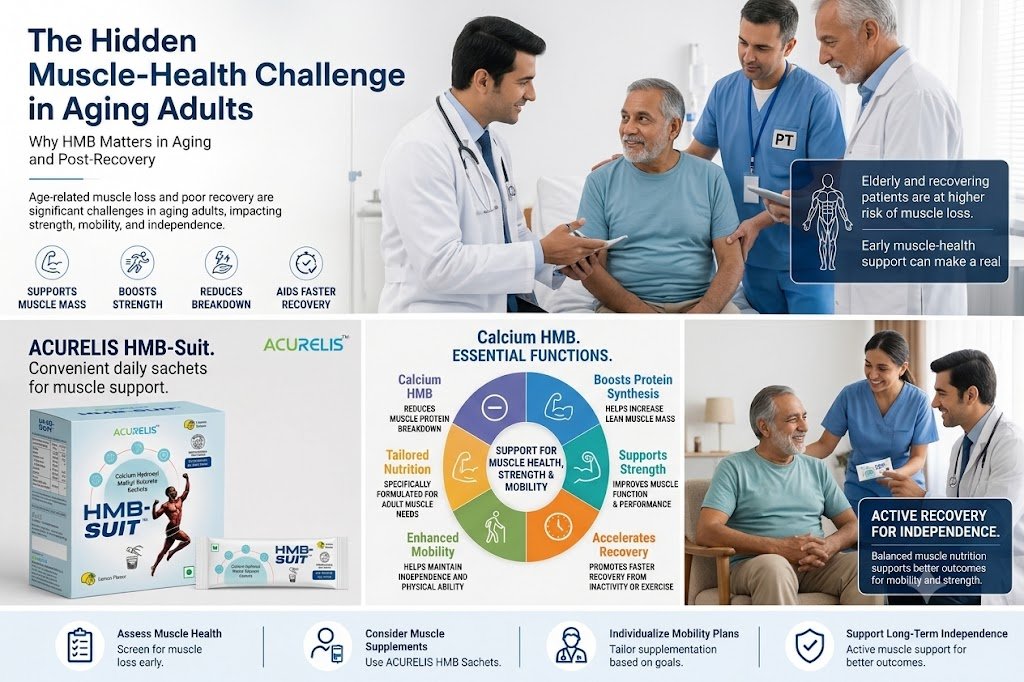
First Time in India: Introducing HMB-Suit Water Soluble Sachet
Recognizing the critical unmet need for targeted muscle preservation in Indian ICUs and recovery wards, Acurelis Lifesciences is proud to announce the first-of-its-kind launch in
India: HMB-Suit.
HMB-Suit is meticulously engineered to provide the precise clinical dosage required to combat ICUAW, sarcopenia, and cachexia.
Clinically Optimal Dosage
Each 4Gm sachet delivers 1500mg of Calcium Hydroxyl Methylbutyrate (Ca- HMB), ensuring therapeutic efficacy to halt proteolysis and stimulate anabolism.
Seamless Administration
Highly water-soluble formulation. It can be easily dissolved in water for oral consumption or seamlessly administered via Ryle’s Tube/Enteral feeding in the ICU without clogging.
Zero Added Sugar
Metabolically safe for critically ill patients, diabetics, and those with stress-induced hyperglycemia. It provides pure muscle support without unwanted caloric spikes.
High Patient Compliance
Formulated with a delicious, refreshing lemon flavor, overcoming the palatability issues common with clinical nutritional supplements for conscious, recovering patients.
Fuel their strength. Fortify their recovery. Prescribe HMB-Suit.
Conclusion: A Call to Action for Muscle Preservation
Treating the underlying disease is only half the battle in critical care; ensuring the patient retains the physical strength to return to a normal life is the other. As we advance in critical care medicine across India, it is time we stop viewing muscle as merely a structural tissue and start treating it as the vital organ it is. By anticipating muscle loss within the first 48 hours and intervening aggressively with targeted metabolic support like HMB-Suit, physicians and intensivists can significantly improve weaning times, accelerate rehabilitation, and restore their patients’ quality of life.