
Bone & Joint Wellness: Why Bone Health Requires More Than Calcium
When people think about bone health, calcium is usually the first nutrient that comes to mind.
And calcium is certainly important. Almost all of the body’s calcium is stored in bones and teeth, where it contributes to their structure and strength. But healthy bones are not built by calcium alone. Vitamin D, vitamin K, magnesium, folate, vitamin B12 and other nutrients also contribute to different aspects of normal bone, nerve and musculoskeletal function. (Open Data Sharing)
This becomes particularly relevant as people get older.
Age-related changes, reduced physical activity, inadequate dietary intake, limited exposure to sunlight, sedentary lifestyles and certain medical conditions can all influence musculoskeletal health. Maintaining mobility therefore requires a broader approach that combines nutrition, exercise, appropriate medical care and regular assessment of individual risk factors.
For healthcare professionals, this means looking beyond a single nutrient and considering the overall nutritional requirements of the patient.
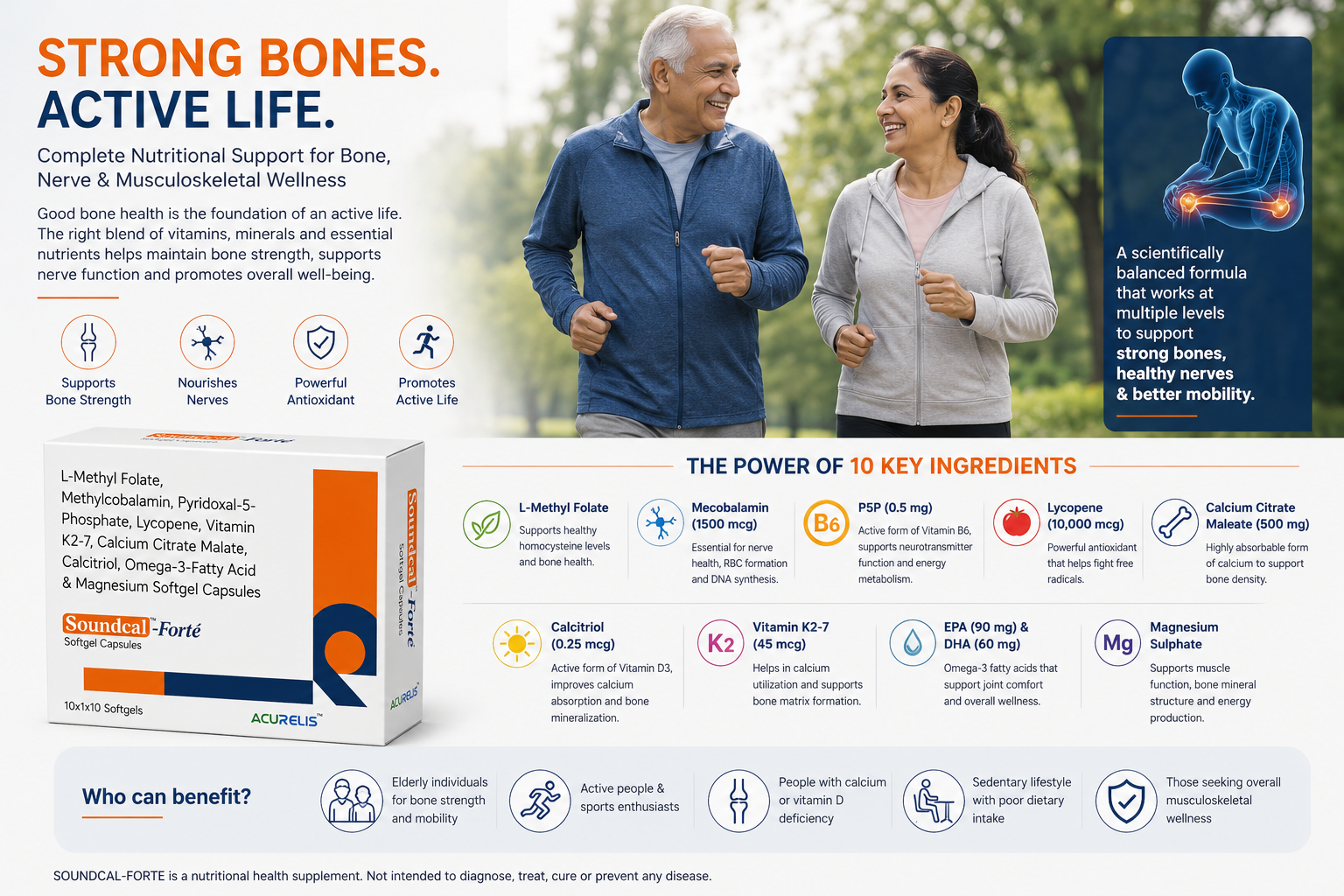
One pharmaceutical formulation designed around this broader approach is SOUNDCAL-FORTE, containing:
- L-Methylfolate – 1 mg
- Mecobalamin – 1500 mcg
- P5P – 0.5 mg
- Lycopene – 10,000 mcg
- Calcium Citrate Maleate – 500 mg
- Calcitriol – 0.25 mcg
- Vitamin K2-7 – 45 mcg
- EPA – 90 mg
- DHA – 60 mg
- Magnesium Sulphate
The combination brings together bone-related nutrients with vitamins, omega-3 fatty acids and antioxidant support in a single softgel formulation.
Why Bone Health Matters at Every Age
Bone is living tissue. Throughout life, old bone is continuously broken down and replaced with new bone.
During childhood and early adulthood, bone formation generally exceeds bone loss, allowing bone mass to increase. With advancing age, however, the balance can gradually change. Bone loss may accelerate, increasing the risk of low bone density and fractures.
This is why bone health should not be considered an issue only for elderly patients.
Building and maintaining adequate bone strength earlier in life creates an important foundation for later years. Regular physical activity, sufficient calcium and vitamin D, adequate protein intake and avoidance of tobacco are among the lifestyle factors commonly considered in maintaining skeletal health.
Calcium is particularly important because it provides the structural mineral component of bone. The body also uses calcium for muscle contraction, nerve transmission and other physiological functions. (Open Data Sharing)
However, calcium metabolism is closely linked with vitamin D and other regulatory mechanisms.
Calcium and Vitamin D: The Foundation of Bone Mineralization
Calcium and vitamin D are two of the most recognized nutrients associated with skeletal health.
Calcium provides the mineral component required for bone structure, while vitamin D helps the body absorb calcium efficiently. (Open Data Sharing)
This relationship explains why calcium supplementation is often considered alongside vitamin D therapy when clinically appropriate.
SOUNDCAL-FORTE contains Calcium Citrate Maleate 500 mg along with Calcitriol 0.25 mcg.
Calcitriol is the hormonally active form of vitamin D and plays a role in calcium and phosphate homeostasis.
Unlike conventional nutritional vitamin D preparations, calcitriol is a pharmacologically active form that requires appropriate clinical judgment. Its use should therefore be guided by the treating physician, particularly because excessive calcium or calcitriol exposure can result in clinically significant abnormalities.
For patients receiving such formulations, appropriate monitoring may be necessary depending on the indication and clinical situation.
Why Vitamin K2-7 Is Relevant to Bone Health
Vitamin K is another nutrient with an important role in bone metabolism.
Vitamin K-dependent proteins are involved in bone metabolism, including osteocalcin, a protein produced by bone-forming cells. (Open Data Sharing)
Among the menaquinones, MK-7 (vitamin K2-7) has received considerable scientific interest because of its longer half-life compared with some other forms of vitamin K.
SOUNDCAL-FORTE provides Vitamin K2-7 – 45 mcg.
The inclusion of vitamin K2-7 alongside calcium and calcitriol reflects a broader approach to supporting the nutritional pathways involved in skeletal health.
However, vitamin K supplementation requires particular consideration in patients taking vitamin K-antagonist anticoagulants such as warfarin, because changes in vitamin K intake can affect anticoagulation management. (Open Data Sharing)
Magnesium: The Often-Overlooked Mineral
Calcium tends to receive most of the attention in discussions about bone health, but magnesium is also an important mineral involved in normal physiological processes.
Magnesium participates in numerous enzymatic reactions and contributes to normal muscle and nerve function. It is also relevant to bone mineral metabolism.
SOUNDCAL-FORTE includes Magnesium Sulphate as part of its multi-component composition.
For healthcare professionals, the presence of magnesium alongside calcium and vitamin D-related components provides an opportunity to consider multiple nutritional requirements when managing patients with musculoskeletal or nutritional concerns.
As with any pharmaceutical formulation, the suitability of the specific magnesium salt and dose should be considered according to the approved product information and the patient’s clinical requirements.
Mecobalamin and the Nerve–Muscle Connection
Bone health does not exist in isolation.
Mobility depends on the coordinated function of bones, joints, muscles and nerves. Nutritional deficiencies affecting the nervous system can therefore influence a person’s ability to remain physically active.
Vitamin B12 is essential for normal blood and nerve cell function and is involved in DNA synthesis. (Open Data Sharing)
Mecobalamin (methylcobalamin) is a form of vitamin B12.
SOUNDCAL-FORTE provides Mecobalamin 1500 mcg, along with L-Methylfolate 1 mg and P5P 0.5 mg.
This combination brings together nutrients involved in important biochemical pathways associated with neurological and cellular function.
It is particularly relevant to a broader concept of musculoskeletal wellness, where maintaining healthy nerve and muscle function is important for mobility and everyday activity.
L-Methylfolate and P5P: Supporting Essential Metabolic Pathways
Folate and vitamin B6 participate in numerous metabolic processes.
L-Methylfolate is the biologically active form of folate involved in one-carbon metabolism, while P5P (pyridoxal-5-phosphate) is the active coenzyme form of vitamin B6.
SOUNDCAL-FORTE combines:
L-Methylfolate – 1 mg + P5P – 0.5 mg + Mecobalamin – 1500 mcg.
These ingredients broaden the formulation beyond conventional calcium and vitamin D combinations, providing nutritional components relevant to neurological and metabolic functions.
This is particularly useful when discussing bone and joint wellness from a whole-patient perspective rather than viewing skeletal health as an isolated issue.
The Role of EPA and DHA in a Broader Wellness Approach
SOUNDCAL-FORTE also contains EPA 90 mg and DHA 60 mg.
EPA and DHA are long-chain omega-3 fatty acids found naturally in fish and seafood. They are important components of cell membranes and participate in several physiological processes. (Open Data Sharing)
Omega-3 fatty acids have been extensively studied in relation to cardiovascular and inflammatory health, although the evidence and clinical relevance depend on the specific indication, dose and patient population.
Their inclusion in SOUNDCAL-FORTE adds another dimension to the formulation, supporting a broader general wellness and musculoskeletal nutrition strategy.
Importantly, the presence of EPA and DHA should not be interpreted as a claim that SOUNDCAL-FORTE treats arthritis, osteoporosis or inflammatory joint disease unless such an indication is specifically supported by the approved product information.
Lycopene and Antioxidant Support
Another component of SOUNDCAL-FORTE is lycopene, a naturally occurring carotenoid with antioxidant properties.
The formulation contains 10,000 mcg of lycopene.
Oxidative processes are a normal part of metabolism, and the body has multiple endogenous antioxidant systems. Dietary antioxidants have therefore attracted significant interest in nutritional and preventive-health research.
Including lycopene alongside vitamins, minerals and omega-3 fatty acids gives SOUNDCAL-FORTE a broader composition than a conventional calcium-only formulation.
This multi-component approach can be particularly relevant when nutritional support is being considered for patients with multiple dietary requirements.
Why a Multi-Nutrient Approach Can Make Sense
Bone and musculoskeletal health involves several biological systems working together.
Consider what is required for normal movement:
Bones provide structural support.
Joints allow controlled movement.
Muscles generate force.
Nerves coordinate movement and sensation.
Nutrition supports the biological processes underlying all of these systems.
This is why a comprehensive formulation may include more than calcium alone.
SOUNDCAL-FORTE combines calcium, calcitriol, vitamin K2-7 and magnesium with B-vitamin derivatives, lycopene and omega-3 fatty acids.
Component | Strength per Softgel | Key Nutritional/Physiological Role |
L-Methylfolate | 1 mg | Folate-related metabolic pathways |
Mecobalamin | 1500 mcg | Vitamin B12-related nerve and cellular functions |
P5P | 0.5 mg | Active vitamin B6 coenzyme |
Lycopene | 10,000 mcg | Antioxidant carotenoid |
Calcium Citrate Maleate | 500 mg | Bone mineral and physiological calcium functions |
Calcitriol | 0.25 mcg | Active vitamin D-related calcium/phosphate regulation |
Vitamin K2-7 | 45 mcg | Vitamin K-dependent bone metabolism |
EPA | 90 mg | Long-chain omega-3 fatty acid |
DHA | 60 mg | Long-chain omega-3 fatty acid |
Magnesium Sulphate | — | Magnesium-related physiological functions |
Composition and dosage should always be interpreted according to the approved product information.
Bone Health Is Also About Staying Active
No pharmaceutical formulation can replace the fundamentals of musculoskeletal health.
Weight-bearing and muscle-strengthening exercise are particularly important for maintaining bone strength and physical function.
Walking, resistance training, stair climbing and other appropriate physical activities can help maintain muscle strength and mobility. Exercise selection should, however, be individualized for patients with osteoporosis, fractures, severe joint disease or significant mobility limitations.
Nutrition is equally important.
A diet containing adequate protein, calcium-rich foods, vegetables, fruits and other nutrient-dense foods provides the foundation for long-term health.
For patients with diagnosed nutritional deficiencies or increased nutritional requirements, physicians may consider appropriate pharmaceutical supplementation.
When Should Bone and Joint Symptoms Be Evaluated?
Occasional muscle soreness after exercise is different from persistent or unexplained musculoskeletal symptoms.
Medical evaluation should be considered when a person experiences:
- Persistent or worsening bone or joint pain
- Recurrent fractures or fractures after minor trauma
- Significant loss of height or change in posture
- Persistent muscle weakness
- Difficulty walking or maintaining balance
- Recurrent numbness or tingling
- Prolonged stiffness or restricted movement
- Symptoms that interfere with daily activities
Depending on the clinical situation, a physician may consider investigations such as serum calcium, vitamin D status, renal function, bone mineral density and other relevant tests.
This individualized approach is particularly important because excessive calcium or active vitamin D can also cause adverse effects in susceptible patients.
SOUNDCAL-FORTE: A Comprehensive Bone & Wellness Formulation
SOUNDCAL-FORTE brings together a broad combination of bone-supportive, neurological, metabolic and antioxidant nutrients in a single softgel formulation:
L-Methylfolate 1 mg + Mecobalamin 1500 mcg + P5P 0.5 mg + Lycopene 10,000 mcg + Calcium Citrate Maleate 500 mg + Calcitriol 0.25 mcg + Vitamin K2-7 45 mcg + EPA 90 mg + DHA 60 mg + Magnesium Sulphate.
Its formulation is designed around the understanding that bone and musculoskeletal wellness is multidimensional.
Rather than focusing exclusively on calcium, SOUNDCAL-FORTE combines calcium and active vitamin D with vitamin K2-7 and magnesium, while also incorporating B-vitamin derivatives, omega-3 fatty acids and lycopene.
For appropriate patients, the formulation can be considered by healthcare professionals as part of a broader physician-directed approach to nutritional and musculoskeletal care.
Conclusion
Strong bones are important, but healthy movement requires much more than strong bones alone.
Calcium contributes to bone structure, while calcitriol plays an important role in calcium and phosphate regulation. Vitamin K participates in bone metabolism, magnesium supports numerous physiological processes, and B-vitamin derivatives contribute to neurological and metabolic functions. EPA and DHA provide long-chain omega-3 fatty acids, while lycopene adds antioxidant support. (Open Data Sharing)
This broader perspective is reflected in SOUNDCAL-FORTE, a multi-component pharmaceutical softgel formulation combining L-Methylfolate, Mecobalamin, P5P, Lycopene, Calcium Citrate Maleate, Calcitriol, Vitamin K2-7, EPA, DHA and Magnesium Sulphate.
For healthcare professionals, the formulation provides a comprehensive option when multiple nutritional pathways are relevant to an individual patient’s clinical requirements.
At Acurelis Lifesciences, our focus is on developing and promoting practical healthcare formulations that respond to real-world clinical needs.
SOUNDCAL-FORTE — Comprehensive nutritional support for bone, nerve and musculoskeletal wellness.
Medical disclaimer: This article is intended for educational and professional healthcare information purposes. SOUNDCAL-FORTE should be used under the supervision of a qualified healthcare professional and in accordance with its approved prescribing information. It should not replace clinical diagnosis, prescribed treatment or individualized medical advice. Patients taking anticoagulants such as warfarin, or those with renal, calcium or vitamin D-related disorders, should inform their treating physician before use.